此页面上记录的 Bun.fileBun.write API 经过了大量优化,代表了使用 Bun 执行文件系统任务的推荐方式。对于 Bun.file 尚未提供的操作,例如 mkdirreaddir,您可以使用 Bun 的 几乎完整的 node:fs 模块实现。

读取文件 (Bun.file())

Bun.file(path): BunFile 使用 Bun.file(path) 函数创建一个 BunFile 实例。一个 BunFile 代表一个延迟加载的文件;初始化它并不会真正从磁盘读取文件。
const foo = Bun.file("foo.txt"); // 相对于当前工作目录
foo.size; // 字节数
foo.type; // MIME 类型
该引用符合 Blob 接口,因此可以以各种格式读取内容。
const foo = Bun.file("foo.txt");

await foo.text(); // 内容作为字符串
await foo.json(); // 内容作为 JSON 对象
await foo.stream(); // 内容作为 ReadableStream
await foo.arrayBuffer(); // 内容作为 ArrayBuffer
await foo.bytes(); // 内容作为 Uint8Array
文件引用也可以使用数值 文件描述符file:// URL 创建。
Bun.file(1234);
Bun.file(new URL(import.meta.url)); // 引用当前文件
一个 BunFile 可以指向磁盘上不存在文件的位置。
const notreal = Bun.file("notreal.txt");
notreal.size; // 0
notreal.type; // "text/plain;charset=utf-8"
const exists = await notreal.exists(); // false
默认 MIME 类型是 text/plain;charset=utf-8,但可以通过向 Bun.file 传递第二个参数来覆盖。
const notreal = Bun.file("notreal.json", { type: "application/json" });
notreal.type; // => "application/json;charset=utf-8"
为方便起见,Bun 将 stdinstdoutstderr 暴露为 BunFile 的实例。
Bun.stdin; // 只读
Bun.stdout;
Bun.stderr;

删除文件 (file.delete())

您可以通过调用 .delete() 函数来删除文件。
await Bun.file("logs.json").delete();

写入文件 (Bun.write())

Bun.write(destination, data): Promise<number> Bun.write 函数是一个多功能工具,用于将各种负载写入磁盘。 第一个参数是 destination,可以是以下类型之一:
  • string: 文件系统上位置的路径。使用 "path" 模块来操作路径。
  • URL: 一个 file:// 描述符。
  • BunFile: 一个文件引用。
第二个参数是要写入的数据。它可以是以下任何一种:
  • string
  • Blob (包括 BunFile)
  • ArrayBufferSharedArrayBuffer
  • TypedArray (Uint8Array 等)
  • Response
所有可能的排列都使用当前平台上可用的最快系统调用来处理。
输出输入系统调用平台
filefilecopy_file_rangeLinux
filepipesendfileLinux
pipepipespliceLinux
terminalfilesendfileLinux
terminalterminalsendfileLinux
socketfile 或 pipesendfile (如果是 http,非 https)Linux
file (不存在)file (path)clonefilemacOS
file (存在)filefcopyfilemacOS
fileBlob 或 stringwritemacOS
fileBlob 或 stringwriteLinux
将字符串写入磁盘:
const data = `It was the best of times, it was the worst of times.`;
await Bun.write("output.txt", data);
将文件复制到磁盘上的另一个位置:
const input = Bun.file("input.txt");
const output = Bun.file("output.txt"); // 尚不存在!
await Bun.write(output, input);
将字节数组写入磁盘:
const encoder = new TextEncoder();
const data = encoder.encode("datadatadata"); // Uint8Array
await Bun.write("output.txt", data);
将文件写入 stdout
const input = Bun.file("input.txt");
await Bun.write(Bun.stdout, input);
将 HTTP 响应体写入磁盘:
const response = await fetch("https://bun.com");
await Bun.write("index.html", response);

使用 FileSink 增量写入

Bun 提供了一个称为 FileSink 的原生增量文件写入 API。要从 BunFile 检索 FileSink 实例:
const file = Bun.file("output.txt");
const writer = file.writer();
要增量写入文件,请调用 .write()
const file = Bun.file("output.txt");
const writer = file.writer();

writer.write("it was the best of times\n");
writer.write("it was the worst of times\n");
这些块将在内部缓冲。要将缓冲区刷新到磁盘,请使用 .flush()。这将返回刷新的字节数。
writer.flush(); // 将缓冲区写入磁盘
FileSink 的_高水位标记_达到时,缓冲区也将自动刷新;也就是说,当其内部缓冲区满时。这个值是可以配置的。
const file = Bun.file("output.txt");
const writer = file.writer({ highWaterMark: 1024 * 1024 }); // 1MB
要刷新缓冲区并关闭文件:
writer.end();
请注意,默认情况下,bun 进程将保持活动状态,直到此 FileSink 通过 .end() 显式关闭。要选择退出此行为,您可以”取消引用”实例。
writer.unref();

// 稍后"重新引用"它
writer.ref();

目录

Bun 的 node:fs 实现是快速的,我们尚未实现专门用于读取目录的 Bun 特定 API。目前,您应该在 Bun 中使用 node:fs 来处理目录。

读取目录 (readdir)

要在 Bun 中读取目录,请使用 node:fs 中的 readdir
import { readdir } from "node:fs/promises";

// 读取当前目录中的所有文件
const files = await readdir(import.meta.dir);

递归读取目录

要在 Bun 中递归读取目录,请使用带有 recursive: truereaddir
import { readdir } from "node:fs/promises";

// 递归读取当前目录中的所有文件
const files = await readdir("../", { recursive: true });

创建目录 (mkdir)

要递归创建目录,请使用 node:fs 中的 mkdir
import { mkdir } from "node:fs/promises";

await mkdir("path/to/dir", { recursive: true });

基准测试

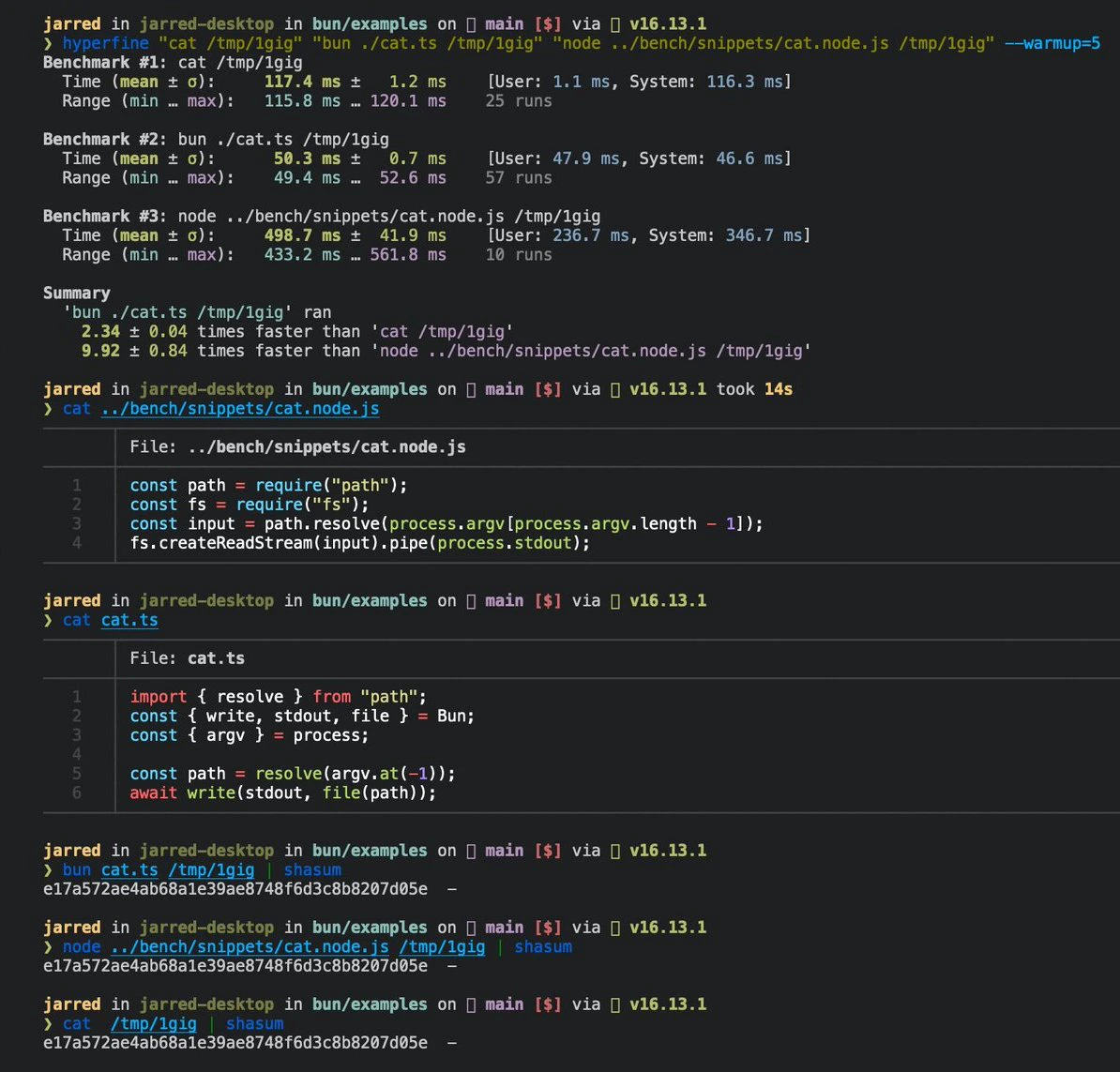
以下是 Linux cat 命令的 3 行实现。
https://mintcdn.com/teemo/2s-4Z6VdGqiCeBNX/icons/typescript.svg?fit=max&auto=format&n=2s-4Z6VdGqiCeBNX&q=85&s=087b260066909db1cd3e9c7292bc34b2cat.ts
// 用法
// bun ./cat.ts ./path-to-file

import { resolve } from "path";

const path = resolve(process.argv.at(-1));
await Bun.write(Bun.stdout, Bun.file(path));
运行文件:
terminal
bun ./cat.ts ./path-to-file
对于 Linux 上的大文件,它比 GNU cat 快 2 倍。
Cat 截图

参考

interface Bun {
  stdin: BunFile;
  stdout: BunFile;
  stderr: BunFile;

  file(path: string | number | URL, options?: { type?: string }): BunFile;

  write(
    destination: string | number | BunFile | URL,
    input: string | Blob | ArrayBuffer | SharedArrayBuffer | TypedArray | Response,
  ): Promise<number>;
}

interface BunFile {
  readonly size: number;
  readonly type: string;

  text(): Promise<string>;
  stream(): ReadableStream;
  arrayBuffer(): Promise<ArrayBuffer>;
  json(): Promise<any>;
  writer(params: { highWaterMark?: number }): FileSink;
  exists(): Promise<boolean>;
}

export interface FileSink {
  write(chunk: string | ArrayBufferView | ArrayBuffer | SharedArrayBuffer): number;
  flush(): number | Promise<number>;
  end(error?: Error): number | Promise<number>;
  start(options?: { highWaterMark?: number }): void;
  ref(): void;
  unref(): void;
}